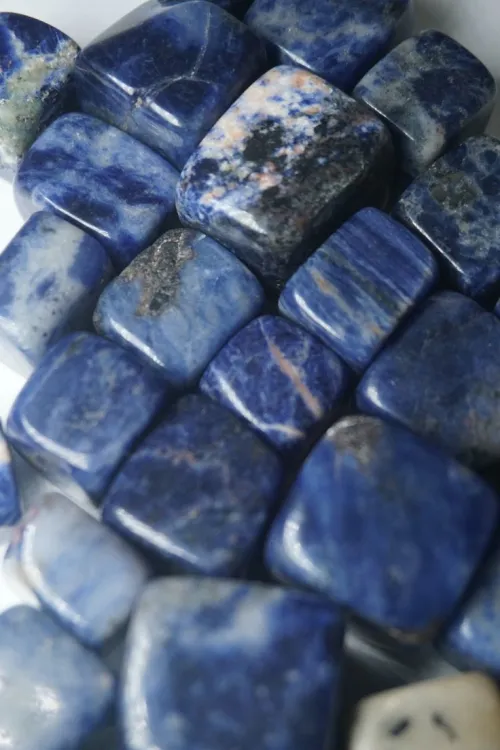
Sodalite exhibits primarily a vitreous (glass-like) to slightly greasy luster, resulting from its sodium-rich aluminosilicate composition and internal crystal structure. This optical property varies based on surface texture, light exposure, and treatment conditions, distinguishing it from minerals with metallic or resinous qualities.

You're examining a vibrant blue decorative stone in a gallery, or comparing jewelry listings online when the description "distinctive sodalite luster" catches your eye. Though aesthetically compelling, this specialty term creates uncertainty for many observers. Does it indicate quality? Does it help distinguish synthetic replicas? For mineral enthusiasts, designers, and mindful shoppers navigating terminology gaps, understanding luster meaning becomes essential evaluation criteria. When identical descriptions appear across different price tiers, or when stones labeled "sodalite" display conflicting visual properties, foundational knowledge provides confidence in identification and decision-making.
What fundamentally constitutes sodalite's surface reflection? Unlike informal descriptors like "sparkly" or "dull," luster classification relies on standardized scientific comparison to everyday materials. The vitreous category indicates resemblance to reflected light from broken glass. Unlike pyrite's metallic glitter or amber's resinous depth, sodalite typically fits this vitreous framework. However, surface irregularities may shift some specimens toward "greasy," suggesting a texture akin to light diffusion on candle wax. Mineral formation processes contribute decisively to this optical identity. Sodalite forms in silica-deprived igneous environments where its cubic crystal system develops. While visible crystals are rare, this underlying atomic arrangement guides light reflection consistency observed today.
Sodalite’s specific silicate structure directly explains its light interaction pattern. Atoms bond in cage-like frameworks containing sodium and chloride, creating a homogenous matrix with consistent reflective behavior. Variable light absorption occurs due to sulphur compounds, generating distinctive blues while minimally interfering with surface shine. Transparency nuances, which range from opaque fragments to thin translucent slabs, influence internal light transmission but maintain identical fundamental luster characteristics. Similarly, hardness limitations that render sodalite vulnerable to incidental abrasion alter light reflection through physical degradation rather than compositional changes.
Human modifications substantially alter perceived visual qualities while avoiding synthetic fabrication. When ground against progressive abrasives, the mineral's surface smooths to optical flatness, enhancing mirror-like reflection typical of fully realized vitreous luster. Without such polishing, natural grain boundaries scatter light to cause greasy impressions.
Reliable identification requires controlled viewing contexts. Bright, non-directional lighting creates ambient glare obscuring nuances. Instead, use focused light sources like adjustable lamps to reveal texture-dependent characteristics:
Some expect vibrant sparkle akin to high-refractive gems. Instead, sodalite offers medium-intensity reflections. Its beauty emerges from color saturation rather than diamond-like brilliance. Similarly, cloudy zones within translucent sections don't indicate lower quality. These represent typical mineralogical variations that minimally affect luster consistency.
Positioning sodalite among common parallels clarifies its unique profile. Lapis lazuli, frequently confused for sodalite, shows similar blue coloring but contains speckled pyrite inclusions causing metallic reflections absent in pure sodalite. Azurite provides deeper blues with notably higher surface shine derived from distinct copper composition. Among silicate peers like quartz, sodalite exhibits softer reflectivity despite comparable basic luster categories. These subtle discriminators support correct geological classification.
Light exposure minimally affects sodalite luster, but physical interaction creates noticeable change. Given moderate hardness, placement alongside harder minerals risks surface scratching that permanently diffuses light reflection. Similarly, avoid ultrasonic cleaners which may erode polished finishes through vibration. Simple dusting preserves original shine characteristics. Though moisture temporarily intensifies reflectivity through refractive matching, prolonged wetness risks structural damage irrelevant to luster alone.
A clear grasp of vitreous dominance combined with an understanding of texture-related greasy effects provides reliable identification anchors. When evaluating sodalite items, observers should concentrate energy on visual uniformity checks under adequate lighting, tactile feedback assessment without oils or lotions, and careful storage condition planning to limit abrasion. Recording basic observations against established mineral databases often resolves ambiguous cases. Such prioritized, evidence-centered approaches build sustainable expertise.
Q: Does luster quality indicate sodalite authenticity?
A: Genuine sodalite consistently shows vitreous-to-greasy luster matching geological standards. Artificial materials often present exaggerated shine not found in natural specimens.
Q: How do sodalite colors influence perceived luster?
A: Deeper blues might visually intensify shine through color contrast, whereas pale pieces can appear softer. Actual reflected light measurements typically remain constant across hues without treatment.
Q: Why does sodalite occasionally feel oily?
A: This tactile sensation aligns with luster classification. Greasy types contain microscopic textures causing both optical diffusion and smoother friction against skin. Natural oil residues may enhance this perception temporarily.
Q: Can sunlight exposure degrade sodalite luster?
A: Direct UV light won't affect luster chemically, but accumulated dust or damage from poor storage may gradually reduce shine quality. Display cases prevent particle-induced abrasion.
Q: What causes luster variations between specimens?
A: Natural formation conditions like crystal size, vein impurities, and regional mineral concentrations lead to minor differences. These surface-level variations belong within normal parameters.


$
